The Woodstock Model Railroad Club invites you to come along with as together we build an empire. Stay tuned for progress updates, tips and techniques. All comments are welcome. Email ljbrinker@yahoo.ca

Thursday, October 10, 2013

Cement Plant

Glen first built a mockup of the plant to hold the area needed for this sprawling structure.


completed model

Spotlight on Glen McDonald

(Glen McDonald was the first member to step up and give an account of his railroading history) My personal model railroad history goes back to Lionel and other tinplate trains in my youth but no operating layout until I came back to Canada after teaching Canadian military personnel children in West Germany in the mid 1960's. I brought N gauge Arnold Rapido trains back with me and set up a European style layout that satisfied me for a time. My older doctor brother was and continues to be a total train chaser all over North America. My sons and I joined him at times riding Norfolk Southern's original F1 from Lexington, Kentucky to Chattanooga, Tennessee and seeing the original Steamtown in New England and latter in Pennsylvania. We have paid our homage at Horseshoe Curve near Altoona and the list goes on. I started collecting HO locomotives and cars in the mid 80's and now have a temporary basement layout which will not proceed further as I am not a lone wolf and our new Woodstock Model Railroad is the way to go for me.
Glen is shown helping ballast track

Sunday, October 6, 2013

Harbor Front Buildings

Harbor buildings Scratch built after Sam Cahoon's Moorings a model on Bob Hayden and Dave Frary's, Thatcher's Inlet layout. The walls are a combination of clapboard and board and batten siding. Roofs are leftovers from other projects. The buildings were weathered with various washes and ground chalk. Signs and other details were added. The front deck was made of scribed siding, stained and then sanded to suggest heavy traffic patterns.

Spotlight on Larry Brinker

This is the first article introducing our club members and their model railroading journey. Like most, my first train was a Lionel .  I got to use an old farm table that was in an upstairs bedroom, to set up my empire.  Next, I built an interlocking frame of 2 X 2 inch lumber in shop class at school.  Thank goodness it was too large to put together at school as I miscalculated some of the notches.  I never finished that empire.  Then life happened, work that is, so model railroading took a backseat.  One day I saw a Postage Stamp Train set, wow, this will fit in an apartment, won't it?  I moved to a house too soon to finish that one.  Life happened again ( kids) but I did get back to it by building a double decked N scale layout. Then I visited Don's layout one day, he hasn't noticed yet so I just keep going back.  That's where I got the bug for HO, so I now have a back woods, mountain railroad call The Grants Pass Railroad, (you can see it by going to grantspassrailroad.blogspot.com ).  Now we have a railroad club where I get to model railroad with another great bunch. That's me in the red sweatshirt , writing something important (I'm sure) on the bench work .

Saturday, October 5, 2013

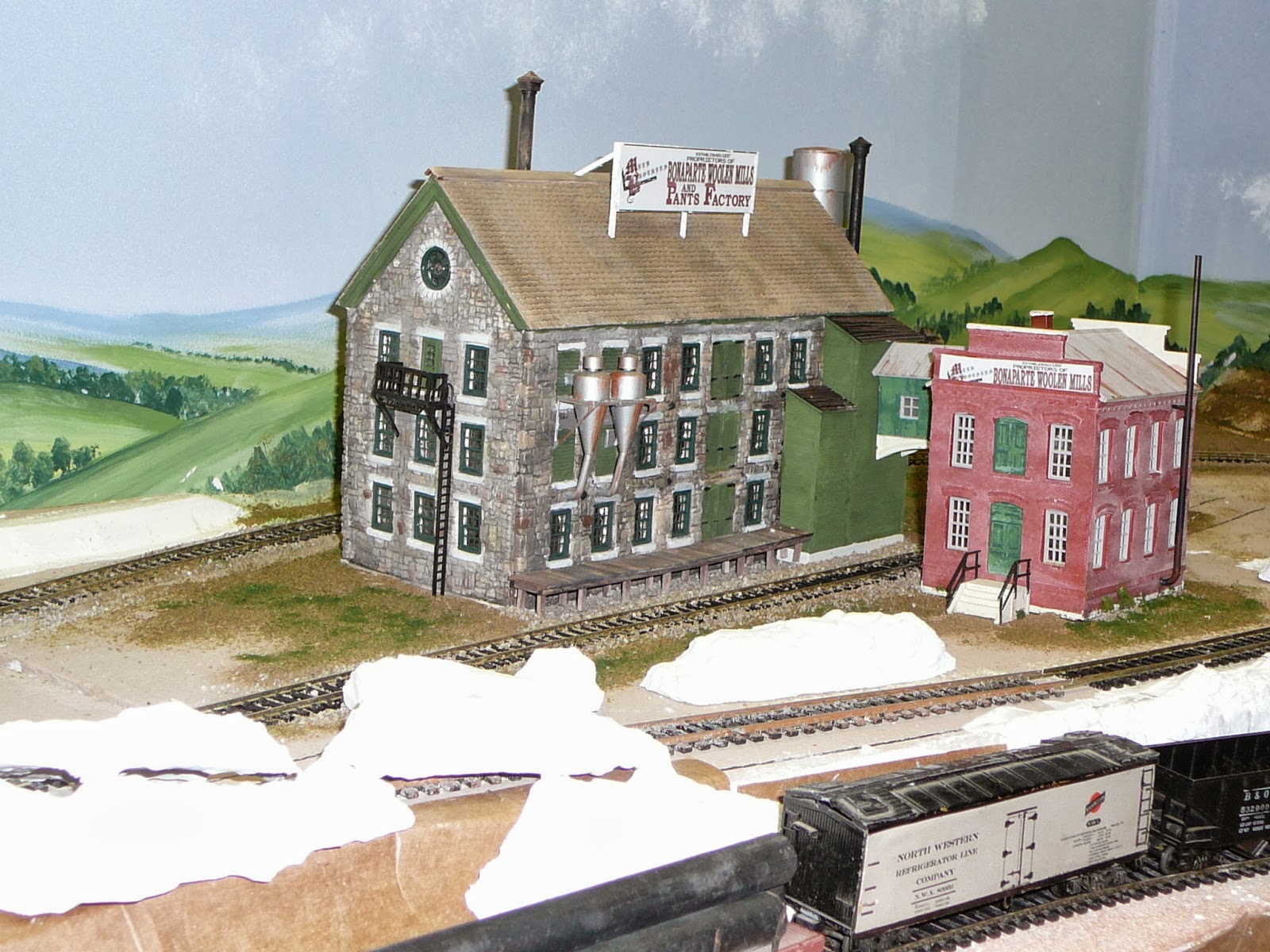
Bonaparte Woollen Mill

The stone building are cast from a borrowed mold.  The castings were glued together and interior bracing was added, including roof bracing.  All the window and door sills were painted light grey.  Using earth tones, many individual stones were painted and a thin black wash was then applied to highlight mortar lines and stone detail. A plastic sheet of shingles painted light brown, was glued to the roof.  It was weathered with washes go green, grey, brown and black.  A total of 68 windows were painted, glassed and installed (actually some were covered over by doors, building extensions or just boarded over).  A brick office from the Delaney Iron Works, with it's bridged hallway was added to one side of the building.  Details were added and weathered.

The Name Game

I personally find it difficult, to not only name my layout but also the towns on it.  If you are modeling an existing line or location, problem solved.  With the Woodstock layout,we are at that spot.  We have a layout, no name, we have seven towns, and a branch line, no names.  There are several ways to approach this. You can name the towns in alphabetical order (Ames, Brant, Craig, etc.) that way all operators, new and old, would know what town is next and in what direction. You could name them after club members (I see all kind of problems with that, Owen and Fox would work, but Hietown and Brinkerville, don't cut it). You could name them for something unique about the town, Port, for the port, Stockton, for the town with the stock yard, Junction, for the town with a junction, oops we have two). Elsewhere for staging because if the car is not on the layout, it must be elsewhere.  The  latter gives meaning to the names chosen but lacks the ABC effect, unless we can combine both approaches.  Let's see, starting in Elsewhere (staging) we proceed to Freeport (port) then on to Gulch (the town at the end of the gulch, there's no buildings there yet, so I don't know what else to call it).  Horseshoe Bend (this is where the mainline makes a 360 degree turn and has a stock (horse/cattle) pen). Well anyway, stay tuned for more from the name game

Thursday, October 3, 2013

Skewed Perception

Model railroaders have a different view of things around us.  Some people see a ball point pen cap, we see an exhaust fan, a fancy toothpick is really a concrete fence baluster, reusable straws are steal chimneys, markers are vertical oil tanks, beads are lightning rods, pill bottles are good part containers, scenery spreaders, umm......